

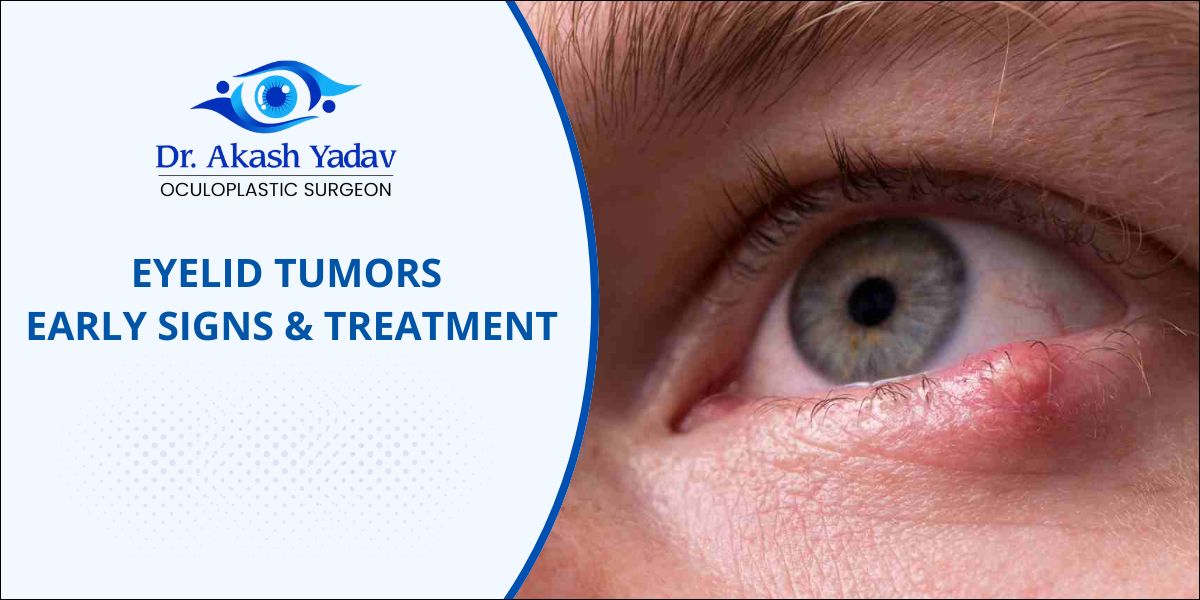
An eyelid tumor may begin as a small, painless bump, a change in the skin, or a spot that simply does not seem to heal. Because many eyelid growths look harmless in the early stages, they are often ignored. However, some eyelid tumors can be cancerous and may gradually affect the surrounding tissues or even vision if left untreated.
Understanding the early warning signs and knowing when to consult an eyelid specialist can help with timely diagnosis and treatment.
What Are Eyelid Tumors?
Eyelid tumors are abnormal growths that develop on or around the eyelid. They may be benign (non-cancerous) or malignant (cancerous). Common benign growths include cysts, papillomas, and certain moles, while malignant tumors may include basal cell carcinoma, squamous cell carcinoma, or sebaceous gland carcinoma.
Not every eyelid lump is cancerous. However, a growth that changes in appearance, repeatedly returns, bleeds, or does not heal should be evaluated by an eye specialist.
Early Signs of Eyelid Tumors
Recognizing changes in the eyelid can encourage earlier medical evaluation. Watch for:
- A new lump or growth on the eyelid
- A sore or wound that does not heal
- Repeated bleeding or crusting
- Changes in the size, shape, or color of an eyelid spot
- Loss of eyelashes around a particular area
- Thickening or swelling of the eyelid
- Persistent redness or irritation
- A recurring cyst-like swelling in the same location
- An eyelid becoming distorted or turning inward/outward
- A growth that gradually increases in size
One particularly important warning sign is loss of eyelashes near an eyelid lesion. This can sometimes indicate that the growth is affecting the structures from which the eyelashes arise.
When Should You See a Doctor?
A small eyelid bump may be caused by something as common as a stye or blocked oil gland. But if the swelling persists, keeps returning, changes appearance, or is accompanied by bleeding, ulceration, or eyelash loss, it is important to seek professional evaluation.
Early assessment is especially valuable because treatment may be simpler when a suspicious lesion is detected before it becomes larger or spreads into nearby tissues.
How Are Eyelid Tumors Diagnosed?
An ophthalmologist or oculoplastic specialist generally examines the eyelid closely and assesses the size, location, appearance, and characteristics of the lesion.
If the growth appears suspicious, a biopsy may be recommended. During a biopsy, a small sample of tissue is examined under a microscope to determine whether the lesion is benign or malignant.
The treatment approach depends on the tumor type, size, location, and whether surrounding tissue is involved.
Treatment for Eyelid Tumors
Treatment varies from patient to patient. Benign lesions that are causing discomfort, irritation, cosmetic concerns, or functional problems may be removed through a minor procedure.
For suspicious or cancerous eyelid tumors, surgical excision is commonly used to remove the abnormal tissue. In some cases, specialized techniques may be required to ensure adequate removal while preserving as much healthy eyelid tissue as possible.
Reconstructive eyelid surgery may also be considered when removal creates a significant tissue defect. The goal is not only to remove the tumor but also to preserve eyelid function, eye protection, and appearance.
Eyelid Tumor Excisions in Pune
For patients looking for an eyelid tumor excision doctor in Pune, Dr. Akash Yadav provides evaluation and surgical management of eyelid lesions. A thorough assessment can help determine whether an eyelid growth requires observation, biopsy, or surgical removal. If you notice a persistent eyelid lump, unexplained skin changes, bleeding, or loss of eyelashes, consulting a qualified specialist can help ensure appropriate treatment at the right time.
Don’t Ignore Persistent Eyelid Changes
An eyelid tumor does not always cause pain, which is why visual changes in the eyelid can easily be overlooked. A persistent lump or unusual skin change should not automatically be assumed to be a simple stye or cyst.
Early evaluation can help identify potentially serious lesions and provide a better opportunity for appropriate treatment. If you notice a growth that is changing, recurring, bleeding, or affecting the eyelashes or eyelid shape, schedule an eye examination rather than waiting for it to disappear on its own.
Frequently Asked Questions
1. Are all eyelid tumors cancerous?
No. Many eyelid tumors are benign, but suspicious or changing lesions should be evaluated by a specialist.
2. What is a common warning sign of eyelid cancer?
A persistent growth with eyelash loss, bleeding, ulceration, or changes in appearance can be a warning sign.
3. Can eyelid tumors be removed?
Yes. Depending on the type and location, eyelid tumors can often be removed surgically.
4. Is eyelid tumor removal painful?
The procedure is generally performed with appropriate anesthesia. Your doctor will explain the expected discomfort and recovery.
5. When should I see an eyelid specialist?
See a specialist if an eyelid lump persists, repeatedly returns, grows, bleeds, changes appearance, or causes eyelash loss.
